












Key Takeaways:
- A dog is overweight when excess body fat pushes them above their ideal body condition. Check by feeling for the ribs, looking for a waist from above, and a belly tuck from the side, ideally confirmed with a body condition score.
- Weight matters for longevity and joints: Excess fat both mechanically loads the joints and releases inflammatory compounds that worsen arthritis.
- Safe weight loss is gradual and vet-guided—about 1–2% of body weight per week—achieved by measuring portions, keeping treats under ~10% of daily calories, and increasing activity slowly.
- Feed for target (ideal) weight, not current weight, and choose a complete-and-balanced food; fresh food can help via fullness and easy portioning, but weight loss ultimately comes down to a calorie deficit.
How to tell if your dog is carrying extra weight, why it matters for their health and longevity, and a safe, step-by-step approach to helping them reach a healthy weight.
Have you ever found yourself wondering “is my dog overweight?” You’re not alone! In fact, obesity is one of the most common diseases veterinarians see in their patients. In short: A dog is overweight when excess body fat pushes them above their ideal body condition, and the safest way to help is a gradual, vet-guided plan built on portion control, a complete and balanced diet, and regular activity.
To help ensure your pup lives a happy, healthy, and long life, here are the top signs that your dog may need to lose weight and a step-by-step guide to helping them get there.
In This Guide:
- Signs your dog may be overweight
- How do I check my dog’s body condition score?
- Why does my dog’s weight matter?
- How do I help my dog lose weight safely?
- How much should I feed my dog to help them lose weight?
- Does fresh dog food help dogs lose weight?
- What to look for in a food for weight management
- Helping senior dogs maintain a healthy weight
- FAQs
Signs your dog may be overweight
Five signs point to excess weight in dogs: inconsistent feeding portions, ribs that are hard to see or feel, a waist that’s disappeared, low energy, and eating as the dog’s main activity. Any one of these is worth a closer look with a body condition check.
Sign #1: Feeding instructions aren’t consistently followed. Free-feeding (leaving food out all day) or eyeballing portions with a random cup or scoop easily leads to overfeeding. Follow the feeding guidance on the food package, and measure with a standard measuring cup, or better yet, weigh your dog’s food on a scale to be spot-on. Freshpet’s slice-and-serve rolls include serving-size marks based on your dog’s weight, which makes accurate portioning simple.
Sign #2: You can’t see or feel your dog’s ribs. There are two quick at-home checks. Visually, the ribs closest to the belly should be faintly visible. By feel, you should be able to feel the ribs under a thin layer of skin and fat as you run your hand along the side of the chest. If they’re buried and hard to find, or you have to push down a lot to feel them, there may be too much fat covering them.
Sign #3: You can’t see your dog’s waist. Looking down from above, or from the side, your dog should have a visible waist. A straight, “bread loaf” or “ottoman” profile, or a waistline that is wider than the ribcage, strongly suggest excess weight.
Sign #4: Your dog has low energy levels. Extra weight puts stress on the joints and makes moving around harder, so overweight dogs often become less active—reluctant to run, play, or tackle the stairs, and more inclined to become “couch potatoes.”
Sign #5: Eating seems to be your dog’s main activity. Overeating without enough activity contributes to weight gain. But if a dog gains weight without obvious overeating, look for “secret meals”—other family members or well-meaning neighbors slipping them food, and don’t forget to count dental chews and supplements that could be adding unintended extra calories. Certain medical conditions, like an underactive thyroid (hypothyroidism), can also reduce a dog’s metabolic rate and cause them to gain weight without any change in intake. Your veterinarian can help screen your dog for medical conditions that can cause weight gain with a simple blood test.
How do I check my dog’s body condition score?
Body condition score (BCS) is a hands-on and visual way to assess whether a dog is underweight, ideal, or overweight. The World Small Animal Veterinary Association publishes the standard scale used by veterinarians: usually 1 to 9, where 1–3 is underweight, 4–5 is ideal, and 6–9 is overweight. It turns the informal rib and waist checks above into a repeatable method you can use to track progress over time.
The 4-step at-home body condition check:
- Feel the ribs: Easily felt under a thin layer of fat, like the back of your hand
- Look from above: A visible waist behind the ribs, roughly an hourglass shape
- Look from the side: An upward tuck where the belly rises toward the hips
- Feel the spine & tail base: Bones felt easily, not buried under fat
If the ribs are hard to find, the waist has disappeared, or there’s no tuck, your dog is likely overweight. Your veterinarian can confirm an exact BCS and use it as a baseline for a weight plan.
Why does my dog’s weight matter?
Keeping your dog at a healthy weight is one of the most impactful things you can do for their long-term health and longevity. Excess weight is linked to a shorter lifespan and to a range of serious conditions, most notably arthritis and worsening joint disease.
The weight–joint connection runs two ways. Extra pounds mechanically load the joints with every step, and because body fat is metabolically active tissue that releases pro-inflammatory mediators, excess weight can worsen conditions like osteoarthritis. Beyond the joints, excess weight is associated with reduced mobility, lower energy, and a diminished quality of life. For a fuller look at the weight–joint link, see our guide to joint pain and arthritis in dogs.
None of this is about guilt; it’s about love and longevity. Helping your dog maintain a healthy weight is one of the clearest ways to give them more comfortable, active, pain-free years.
How do I help my dog lose weight safely?
If your dog is overweight, the first step is figuring out if they are simply being unintentionally overfed. The World Small Animal Veterinary Association has a helpful calorie chart that lists expected calorie ranges by body weight that you can use to compare an expected daily intake range with what the dog is currently being fed each day.
For dogs that need to lose more than 20% of their body weight (have a BCS of 7 out of 9 or greater) the safest way to help them lose weight is gradually and under veterinary guidance. Cornell University’s Riney Canine Health Center notes that overweight dogs can safely lose about 1-2% of their body weight per week while on a veterinary-therapeutic weight loss diet. This is achieved by measuring portions to control calories, managing treats and extra supplements, and increasing activity. Rapid weight loss is not safe and can create its own health problems, so slow and steady is the goal.
Here’s a safe, ordered plan:
- Measure portions accurately, ideally by weight with a kitchen scale or a standard measuring cup. Don’t forget to include all treats, chews, and supplements when you are adding up daily calorie intakes.
- Compare actual intake with expected for both current and estimated ideal weights. For dogs that are 5-10% over their ideal and have been unintentionally overfed, a simple reduction in treats and extra foods may be enough.
- Work with your vet. Dogs that are more than 10% over their ideal should be evaluated by a veterinarian before starting any weight loss plans. They can rule out underlying conditions and help set a target weight and daily calorie goal specific to your dog.
- Feed a complete and balanced diet appropriate for weight management, so your dog still gets full nutrition on fewer calories.
- Keep treats to no more than about 10% of daily calories and swap in dog-safe foods like green beans or carrots.
- Increase activity gradually with low-impact exercise, building up as your dog’s fitness and stamina improves.
This is where measured, complete-and-balanced food earns its keep. Consistent, portionable servings make a vet-set calorie target much easier to hit day to day.
How much should I feed my dog to help them lose weight?
To help a dog lose weight, most veterinarians recommend feeding for the dog’s target (ideal) weight rather than their current weight. As a starting point, the UC Davis School of Veterinary Medicine notes that each point above ideal on the 9-point body condition scale represents roughly 10 to 15% excess body weight, which can help guide how much of a reduction is appropriate. Treats should stay under about 10% of daily calories. These are general starting points; the exact amounts should be set with your veterinarian based on your dog’s ideal weight and calorie needs.
A few principles make the numbers work:
- Feed to target weight, not current weight: You’re feeding the dog you want, not the dog you have.
- Check the calorie content and feeding guide on the food package, since calorie density varies widely between products.
- Measure every serving so portions don’t creep back up over time.
- Account for treats, supplements, and table scraps, which add up faster than most people expect.
Your veterinarian can calculate a precise daily calorie target based on your dog’s energy requirement for a safe rate of loss, then adjust it as your dog’s weight comes down.
Does fresh dog food help dogs lose weight?
Fresh-cooked food can support weight management, not because it’s inherently “slimming,” but because weight loss ultimately comes down to creating a calorie deficit. Fresh-cooked, complete-and-balanced diets built on lean proteins and whole vegetables with high moisture contents can help a dog feel full and satisfied on fewer calories, and measurable portions make calorie control easier to stick to.
It’s worth being honest: It’s easy to overfeed any diet if you’re not measuring. Portion control matters regardless of what you feed. Weight loss comes from a vet-guided calorie deficit, not from any single product.
What to look for in a food for weight management
A good weight-management food is complete and balanced for your dog’s life stage, calorie-appropriate to help maintain a healthy lean body weight, and built on high-quality protein to preserve muscle even when portions come down. Higher moisture and fiber support fullness, and an easy to measure format keeps servings consistent.
- Complete and balanced for your dog’s life stage
- Appropriate calorie density for a weight-management plan
- High-quality protein to help preserve lean muscle
- Higher moisture and fiber to support fullness on fewer calories
- Easy to measure, portionable format so servings stay consistent
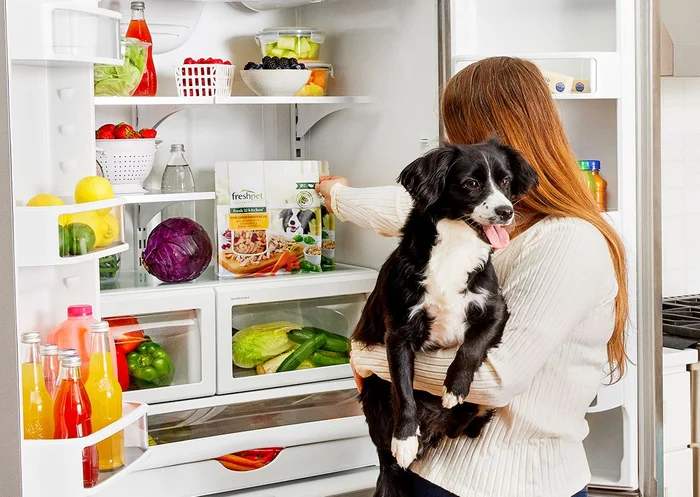
Freshpet’s real-meat, high-moisture recipes (with serving-size marks for easy portioning) are one option that fits these criteria, used as part of a calorie-controlled feeding plan.
Helping senior dogs maintain a healthy weight
Older dogs are prone to weight gain, as both activity levels and metabolism can decline with age. An otherwise healthy senior can do well on a complete and balanced diet with high-quality protein to preserve lean muscle mass, especially when fed in measured portions to help them maintain an optimal body weight.
There are two reasons this matters more with age. Less activity plus a slower metabolism raises the risk of gradual weight gain, and because aging itself causes a gradual loss of muscle tissue in all animals (also called the sarcopenia of aging). Preserving muscle becomes increasingly important as muscle supports the joints and keeps an older dog mobile. Not all senior dogs are the same though and some can have changes in digestion that make it harder to absorb calories and nutrients from the diet.
Any unintentional weight loss is also worth taking seriously. Either way, monitoring your dog’s body condition regularly and regular evaluations by your veterinarian is the best way to keep an aging dog at a comfortable, healthy weight.
FAQs
How do I know if my dog is overweight?
Check your dog’s body condition. You should be able to feel the ribs easily but they shouldn’t be obvious, see a waist when you look down from above, and see an upward tuck at the belly from the side. If you can’t, your dog may be overweight, and your veterinarian can confirm for you.
How much should I reduce my dog’s food to help them lose weight?
Veterinarians often start by feeding for the dog’s target (ideal) weight rather than their current weight. As a general guide, each point above a 5 out of 9 on the 9-point body condition scale represents a roughly 10 to 15% increase in body weight, which can help estimate how much of a reduction makes sense, with treats kept under about 10% of daily calories.
Does fresh-cooked dog food help with weight loss?
Fresh-cooked food can help because complete-and-balanced, protein-rich, higher-moisture recipes can keep a dog feeling full on fewer calories, and measurable portions make calorie control easier. That said, weight loss comes down to a calorie deficit made under veterinary supervision, and fresh-cooked food still needs to be portioned carefully, since any diet can be overfed if not measured.
How fast should a dog lose weight safely?
A safe rate is gradual. According to Cornell’s Riney Canine Health Center, dogs on a therapeutic weight-loss plan can typically lose about 1 to 2% of their body weight per week under vet-guidance.